
How to Get to the Dolomites (and Whether You Really Need a Car)
We’ve always driven to the Dolomites. We lived in Italy with a dog when we first started going, so flying in and renting a car was never part of the equation for us. And honestly, having a car here is easy. You can stay up in the mountains, stop when you want and move between valleys without planning your day around a bus schedule. You can read more about traveling with a dog in our Dolomites with a Dog guide.
But you don’t have to drive. If mountain roads aren’t your thing, there are places where you can arrive by train or bus and get around with public transportation and cable cars. This guide covers both options, including which airports make sense, getting there by train and what to know if you do decide to drive.

The Dolomites cover a big area, so how you get there really depends on where you’re staying. We’ve done the driving ourselves. For airports, trains and routes we haven’t personally used, I’ve used current tourism and transportation information rather than pretending we’ve done it.
Disclosure: Some of the links in this guide are affiliate links. If you book a hotel or tour through them, we may earn a small commission at no additional cost to you. We only recommend places and experiences we genuinely believe will help you plan a better trip. Thank you for supporting thegetAwayZ. Read our full Affiliate Disclosure.
Our Tip: The main roads through the Dolomites have never been a problem for us. The part that can get interesting is the drive up to some of the mountain hotels. We’ve had narrow roads, steep climbs and plenty of switchbacks. If you’re not comfortable with that, check the hotel’s location before you book. Staying in a town or village can make driving much easier.
See our Where to Stay in the Dolomites guide for the different areas and hotels we’ve stayed in and researched.
The Short Answer: The Best Route Depends on Where You’re Staying
If you’re flying to Italy for a Dolomites trip, the best airport depends on which part of the mountains you’re staying in. Venice makes sense for Cortina and the eastern Dolomites, while Innsbruck can be more convenient for parts of South Tyrol. Verona, Treviso and Bergamo can also work, especially if you’re renting a car.
If you’re driving like we do, choose your hotel first and plan the route from there. The Dolomites cover a much bigger area than they look like they do on a map, and driving from one side to the other can take hours.
Dolomites Airports: Which Airport Is Best?
There are a handful of options, and the right one depends on which valley you’re heading for.
| Airport | Best for | Rough transfer time |
|---|---|---|
| Venice Marco Polo (VCE) | Cortina, the eastern Dolomites, most first trips | About 2 to 2.5 hours to Cortina |
| Bolzano (BZO) | Val Gardena and the central valleys | About 20 to 45 minutes |
| Verona (VRN) | Trentino side, Val di Fassa | About 2 to 2.5 hours |
| Innsbruck (INN) | Val Pusteria, northern South Tyrol | About 2 to 2.5 hours |
| Munich (MUC) | More international flights | About 3 to 4 hours |
Research note: There isn’t one best airport for the Dolomites. Choose your airport after you know where you’re staying. Bolzano is only about 40 km from Val Gardena, while Venice is around 270 km away. For Cortina and the eastern Dolomites, Venice and Treviso make much more sense.
If you’re coming from Innsbruck, you might enjoy our Innsbruck Travel Guide and Where to Stay in Innsbruck as a stop on the way. And if coming from Venice you can ready our Venice Travel Guide and Where to Stay in Venice.
Those times are from tourism board and current travel guides. Check your own route on a map, because mountain traffic and closures can change them.
Getting to the Dolomites by Train
You can get to parts of the Dolomites by train, but this works much better for some areas than others. South Tyrol is the easiest side to do by rail. Trains run through Bolzano, Bressanone and Brunico and continue through Val Pusteria to Dobbiaco and San Candido. From those stations, you can connect to buses and shuttles for the final part of the trip.
If you’re coming from Austria, trains run through Innsbruck and the Brenner Pass into South Tyrol. There’s also a direct rail connection from Lienz in Austria to San Candido, which can be useful if you’re staying in Alta Pusteria.
Cortina is different. It doesn’t have a train station. The closest stations are Dobbiaco, about 31 km away, and Calalzo di Cadore, about 35 km away. From there, you continue by bus.
If you’re staying at a participating hotel in South Tyrol, ask about the Südtirol Guest Pass. It includes regional public transportation in South Tyrol, including regional trains and around 200 bus routes.do have train stations.
Do You Really Need a Car in the Dolomites?
NFor the trips we take, yes. We usually stay up mountain roads, settle into one hotel for a few days and use the car to get between valleys and trailheads. Having a car gives us the flexibility we want here.
But you don’t need one. If mountain driving makes you nervous or you simply don’t want to deal with parking and access restrictions, you can plan the trip around public transportation. The key is choosing the right base.
If you’re somewhere in between, rent a car but choose a hotel in a valley town rather than halfway up a mountain. You get the flexibility of having a car without starting and ending every day on a steep mountain road.
Our Tip: If you want the flexibility of a car but mountain driving makes you nervous, stay in a valley town rather than at a hotel halfway up a mountain. You’ll get most of the convenience without having to drive a steep road every time you leave the hotel.
Our Dolomites itinerary includes options for planning the trip with and without a car.
Dolomites Without a Car
You can absolutely do the Dolomites without a car, but where you stay matters. Ortisei and Cortina are two of the easier bases if you want to rely on buses and cable cars, while Bruneck and San Candido also give you access to the train.
You’ll need to plan your days a little more carefully around bus and shuttle schedules, especially for places like Tre Cime and Lago di Braies. The upside is that you don’t have to deal with mountain roads, parking or the increasingly common restrictions on cars at the most popular spots.
If I were planning the Dolomites without a car, I’d choose one well-connected base rather than trying to move between valleys. It’s a different kind of trip from the way we normally travel here, but it’s completely doable.
Driving in the Dolomites
We’ve driven in the Dolomites on every trip, and most of the driving is easier than you might expect. The main roads are paved and well maintained. It’s the smaller roads up to some of the mountain hotels that have made me nervous. They can get narrow and steep with plenty of switchbacks.
That said, I wouldn’t avoid renting a car because of the roads. Just look at where your hotel is before you book. If it’s halfway up a mountain, getting there may be very different from staying in a town down in the valley.
Some things to know before you get in the car:
- Winter tires or chains are required on the roads from about November 15 to April 15.
- Parking colors matter. White lines are free (sometimes with a time limit shown on a disc), blue lines are paid and yellow lines are reserved. Don’t park on yellow.
- Access rules are tightening. Some famous spots now limit or ban cars at certain hours. I list them below.
- Take breaks. Roads are slow, and it’s easy to be late for hotel dinner if you’re on a half-board stay.
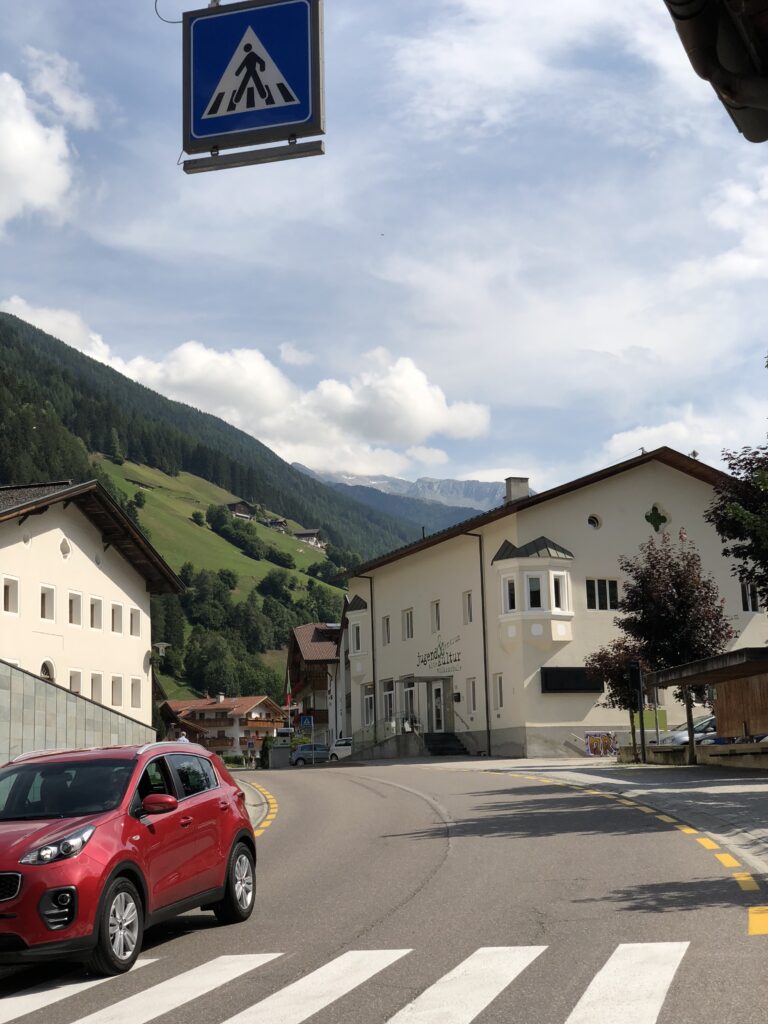
The best part of the drive for us has been the roadside stops. There’s an Autogrill just before the road starts to climb and the vineyards begin. It sells kitchen supplies, has barrels of apples and is where we bought soup from a big cauldron. They call it a soup pot. Stop there.
The 2026 Car Rules at the Most Popular Spots
This is the part you need to check again right before your trip. Access and parking rules in the Dolomites keep changing, and several popular places now require reservations or restrict cars during the day. These are the 2026 rules I found while researching this guide.
- Lago di Braies: During the main summer period from July 1 to September 15, transportation and parking are managed through the official Braies system. There are also additional managed dates before and after the main season. I would book parking or the shuttle before you go rather than assume you can drive straight to the lake.
- Tre Cime di Lavaredo: You now need an online reservation to drive to the parking area at Rifugio Auronzo. For 2026, a car costs €40 and your license plate must be registered before you arrive.
- Alpe di Siusi: Private cars cannot drive up between 9 a.m. and 5 p.m. Starting June 29, 2026, parking at P1 Spitzbühl and P2 Compatsch also requires an advance online reservation. You can only book up to six days ahead.
My advice: If one of these places is important to your trip, check the official access rules when you’re planning and again a few days before you go. Don’t rely on an older blog post for this part.
Where to Go Next
Once you know how you’re getting to the Dolomites, the next decision is where to base yourself. We’ve stayed in several mountain hotels in South Tyrol, and where you stay really does change how much driving you’ll do each day.
Planning your Dolomites trip:
Where to Stay in the Dolomites | Dolomites Itinerary | Dolomites Travel Guide | What Is Half Board in the Dolomites?
If you’re driving, choose your hotel before you map out your days. It makes the rest of the trip much easier to plan.
