
Matera Italy: 9,000 Years of History, Cave Hotels and What to Know Before You Visit

We have been to Matera twice and both times it stopped us in our tracks. There is nowhere else like it. Not in Italy, not in Europe, not anywhere we have traveled in the last eight years of living on this continent. It is a city carved into limestone caves in the region of Basilicata, just above Puglia in southern Italy, and people have lived here for at least 9,000 years. Some historians call it the third oldest continuously inhabited settlement on earth, behind Jerusalem and Aleppo. Italians call it the second Jerusalem. Consider this our Matera Italy travel guide from two trips, two cave Airbnbs and a lot of slippery cobblestones.
The first time we went, we were summering in Puglia and stopped in Matera on the way back from Naples without knowing what to expect. We were not prepared. The second time we went back on purpose because neither of us could stop thinking about it. Both trips we stayed in cave Airbnbs, brought our dogs and left wanting to come back again.
We also did a full episode on Matera on the getAwayZ podcast. If you want to hear us talk through the whole thing before your trip, give it a listen.
If you are planning a Puglia road trip or looking for somewhere in southern Italy that feels completely unlike anywhere else, this is the post for you.
Matera at a Glance
Where: Basilicata, southern Italy, just above Puglia
Getting there: No direct train. Drive (4.5 hrs from Rome, 1 hr from Bari) or take the FAL regional train from Bari (1.5-2 hrs, 5-7 euros)
How long: 1-2 nights. Day trips from Bari are possible but an overnight is worth it
Best time to visit: Spring (April-May) or fall (September-October). Summer is brutally hot
Best for: History lovers, couples, families, photographers, anyone doing a Puglia road trip
Dog friendly: Yes. We brought both our dogs on separate trips
Table of Contents
- How to Get to Matera
- How to Plan Your Visit
- The History: From the Shame of Italy to UNESCO
- Walking the Sassi
- Cave Tours and Museums
- The Viewpoint Across the Ravine
- Where to Eat and What to Try
- The Upper City and the Castle
- Films Shot in Matera
- Visiting Matera with a Dog
- More Matera from the getAwayZ
- Frequently Asked Questions
How to Get to Matera
Matera is not easy to get to. There is no airport, no high-speed train station and no motorway. That remoteness is part of what kept it isolated for so long and part of what makes it feel special now.
There is no direct Trenitalia service into Matera. The city is served by a small private railway called FAL (Ferrovie Appulo Lucane) that runs from Bari. The FAL platform is tucked away in its own building next to Bari Centrale and there is no signboard for it inside the main station. Trains run roughly every 60 to 90 minutes and the ride takes about an hour and a half to two hours depending on whether you get a direct or need to change at Altamura. Tickets are cheap, around five to seven euros each way. On Sundays there are no trains, only buses.
From Matera Centrale station it is about a 20-minute walk downhill to the Sassi.
By car, here are the rough distances:
From Bari: 1 hour, about 65 km. This is the most common route and the easiest
From Naples: 3 hours, about 260 km
From Rome: 4.5 hours, about 480 km
From Florence: 6.5 hours, about 700 km. At this distance, flying to Bari and driving up makes more sense
From Milan: 8 hours, about 930 km. Fly to Bari on a budget airline (1.5 hours) and rent a car
The key connection point is Bari. Whether you are flying, taking a train or driving, most visitors to Matera will come through Bari first. Worth knowing that Matera pairs naturally with Puglia so if you are already planning a trip to Bari, Lecce, Alberobello, Ostuni or Polignano a Mare, Matera is a short detour north and fits right into that itinerary.
No Matera Italy travel guide would be complete without being upfront about this: getting here takes some effort. But that effort is part of what keeps the city from feeling overrun.
How to Plan Your Matera Italy Visit
Here is what we wish every Matera Italy travel guide had told us before our first trip.
How many days: One night is enough to see the main sights and walk the Sassi. Two nights lets you breathe, experience the city at sunset and see it at night when the day-trippers have gone. Most visitors come from Bari and leave by late afternoon. After that the Sassi empty out and the whole atmosphere changes. We would recommend spending at least one night.
Best time to visit: Spring (April and May) or fall (September and October). We went in summer both times and it was like standing inside a pizza oven. The limestone canyon traps and reflects heat and there is almost no shade on the streets between the caves. The caves themselves stay naturally cool inside, which is exactly why people lived in them for thousands of years, but the walking between them in July or August is brutal. If you do go in summer, plan your outdoor time for early morning and retreat to cave restaurants and museums during the middle of the day.
What to wear on your feet: Tennis shoes. We cannot stress this enough. The limestone streets are polished smooth from thousands of years of foot traffic and they are genuinely slippery. We wore flip flops the first time and it was like ice skating. Even with proper shoes you will slide a little. When they filmed the James Bond chase scene here, the Aston Martins could not get traction and they crashed several cars. The production team sprayed thousands of gallons of Coca-Cola on the streets to make them sticky enough for the cars to grip. So if you are slipping around in sneakers, just know that even a sports car had the same problem.
The History: From the Shame of Italy to a UNESCO World Heritage Site
You cannot visit Matera without understanding what happened here. The history is the experience. It is what makes every street and every cave and every view mean something beyond how it looks in a photo.
For centuries, people lived in the cave dwellings with their animals. No electricity, no plumbing, no heat. The only warmth came from the donkeys and goats sleeping in the same room. Water was carried from communal cisterns and public fountains. Infant mortality was devastating. Malaria, cholera and typhoid were constant. Families lived in single cave rooms alongside their livestock.
In 1935, an anti-fascist writer and doctor named Carlo Levi was exiled by Mussolini to Basilicata. His sister stopped in Matera on her way to visit him and was horrified by what she saw. Levi later wrote a book called Christ Stopped at Eboli. The title comes from what the locals told him. Even Christ did not bother to come this far south. The book was published in 1945 and became a sensation, and for the first time Italian politicians had to publicly confront the conditions in the south. The prime minister called Matera a national infamy. The communist leader called it the shame of Italy.
In 1952, the government forced roughly 15,000 residents to leave the caves and relocate to newly built apartment housing. The Sassi were boarded up. Matera became a ghost town. And here is the part that still shocks us: the government actually considered filling all the caves with cement. Just burying them forever.
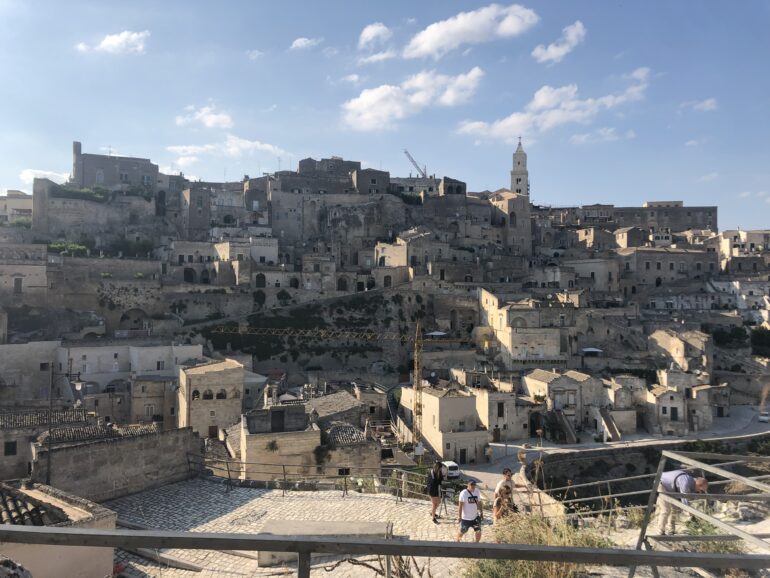
They did not do that, thank God. In the 1980s, college students started exploring the abandoned caves and discovered medieval frescoes inside cave churches, including one called the Crypt of Original Sin that people now refer to as the Sistine Chapel of cave churches. Artists and squatters started moving back in. Preservationists got involved. In 1986 the decision was made to restore the Sassi. In 1993 UNESCO named it a World Heritage Site. In 2019 Matera was named European Capital of Culture and the opening ceremony had 54 marching bands playing Beethoven's Ode to Joy.
About 3,000 people now live in the Sassi again. Cave hotels, restaurants, wine bars, a jazz club and a spa all operate out of the old dwellings. The place that was boarded up and nearly destroyed is now one of the most remarkable cities in Europe. That arc alone is worth the trip.
Walking the Sassi
The Sassi are the ancient cave dwelling neighborhoods and there are two of them. Sasso Caveoso is the more raw and original side with the older cave dwellings. Sasso Barisano is more developed with restaurants and shops. They sit on either side of a ravine with the cathedral up on the ridge between them. You can get to the cathedral from both sides and when you are up there you can walk out onto the roof and look down over the entire ancient city.
The thing that takes a minute to wrap your head around is the layering. There are an estimated eight to ten layers of homes stacked on top of each other, carved into the rock following the natural curve of the canyon. When you are walking along one of the narrow lanes between houses, you are standing on the roof of the house below you. Every level is someone else's ceiling. Once you realize that, you start looking at the whole city differently.
The streets are narrow, often single file, and connected by little stairways that take you up or down to the next level. You can get genuinely lost in the best way. We spent hours just wandering with the dogs. Cash came with us the first time and Rex the second, and both trips involved a lot of meandering on these tiny walkways that wind between the houses. There is quite a bit of shade because everything is so close together and stacked so high, which helps with the heat. But the stone is incredibly slippery, so watch your step.

The cathedral between the two Sassi districts is worth going inside and the roof is worth walking out onto. It is the kind of building where you reach it and realize you are standing on top of centuries of city stacked below you. It is also a useful landmark for orienting yourself if you have gotten turned around in the lanes.
Cave Tours and Museums
We did two different tours on our visits and both were worth it. The first was a walking tour scavenger hunt with a local guide who took us through the Sassi and told us the stories behind the city, including the shame of Italy history and a lot of the smaller details about daily life in the caves. If you are only going to do one thing in Matera beyond walking around, do a guided walking tour. The stories bring everything to life in a way that wandering on your own does not.
The second tour was an actual cave dwelling tour where you go inside and see exactly how people lived, how the churches were carved out and how the whole system worked. You see the rooms where families slept alongside their animals and you understand the scale of what daily life looked like.
There is also an underground tour that we have not done yet but plan to on our next visit. Beneath Piazza Vittorio Veneto there is a massive hand-carved cistern called the Palombaro Lungo that held five million liters of water. You can go down into it and it is supposed to be incredible. The whole city had an ingenious water system with channels carved into the stone that collected rainwater through terracotta gutters and funneled it into underground cisterns. Entry is cheap and it is also naturally cool down there, which makes it a good midday escape in summer.
On our first trip there was a Salvador Dali exhibition set up inside the caves. I do not know if it was permanent or temporary, but having his surrealist sculptures placed inside cave rooms with thousand-year-old frescoes on the walls was something else. That is where Dylan fell in love with Dali. Lisa stayed outside with Cash, so she missed the whole thing but smiled very convincingly when we told her about it.
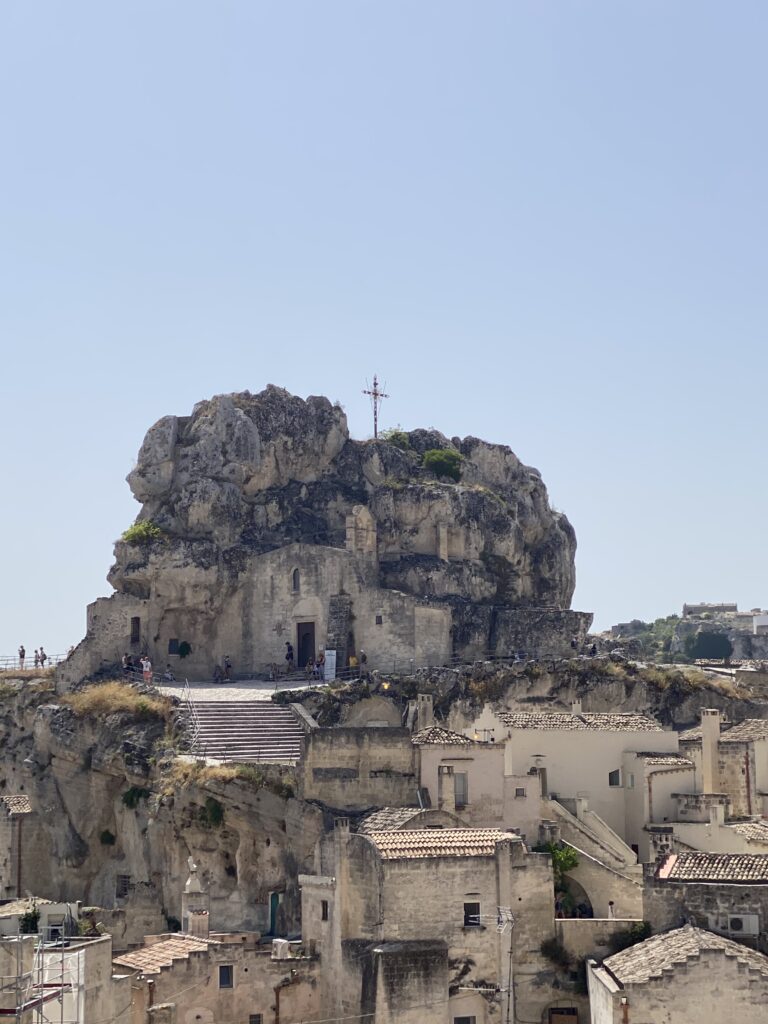
The cave churches are scattered throughout the Sassi and many of them have frescoes that survived centuries of neglect. The Crypt of Original Sin is the most famous, but there are smaller ones tucked into unexpected corners throughout the city. Some are open, some require a guide. If you are doing a walking tour they will show you several.
The Viewpoint Across the Ravine
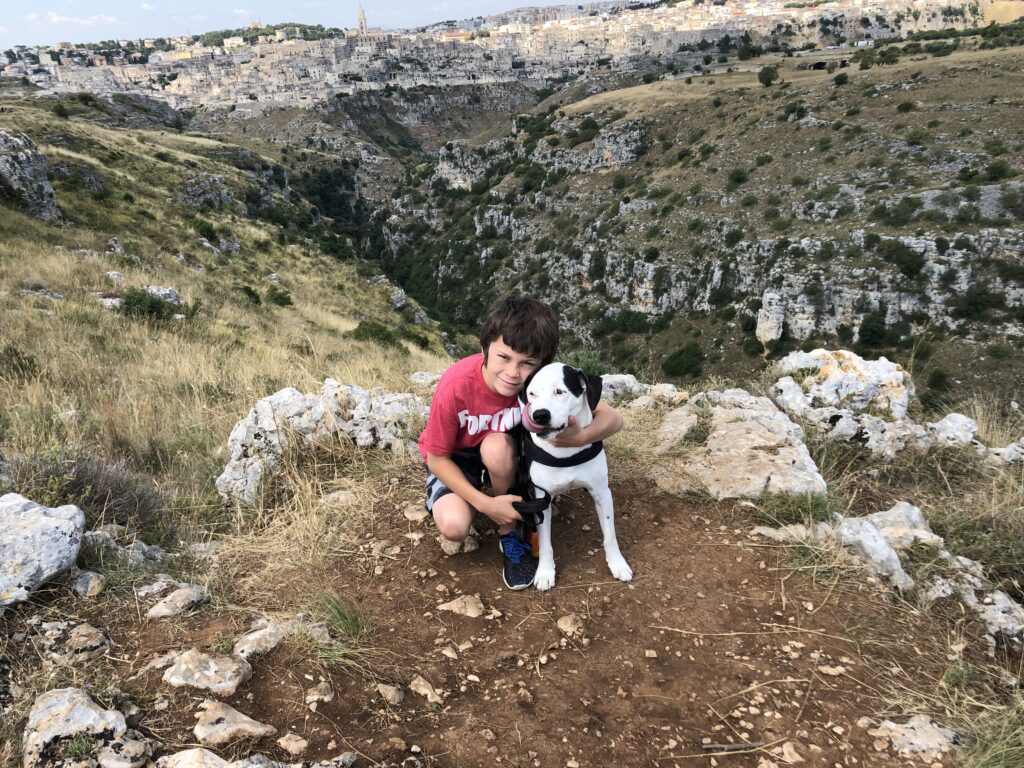
If you want the classic panoramic view of Matera, cross the ravine to the Belvedere di Murgia Timone in the Murgia Materana national park. This is on the opposite side of the canyon and it gives you the full scope of the Sassi rising out of the rock. It is the postcard shot and the view that shows you just how vertical and layered the whole city is.
It is also a nice walk with green space and trails, which is a good break from the limestone heat of the city. We did this with the dogs and it worked well. There is a river down below and the other side of the valley is much greener than the city itself. With or without a dog, it is a nice place to walk around and take a break from the heat.
Where to Eat and What to Try
No Matera Italy travel guide should skip the food because half the reason to come here is what you are going to eat.
Spaghetti all'Assassina
The food moment that will live forever in our house is the assassina. Spaghetti all'assassina is originally from Bari and it was invented by accident in the 1960s when a chef burned a batch of spaghetti in tomato sauce and the kitchen ate it instead of tossing it. The pasta is not cooked in water. You put it directly in the pan with tomato passata and chili and cook it gradually like a risotto, letting it char and get crunchy on the bottom. The name assassina came from two northern Italian customers who jokingly called the chef an assassin because the spice level felt like he was trying to murder them. There is an official academy in Bari called the Accademia dell'Assassina dedicated to protecting the recipe.
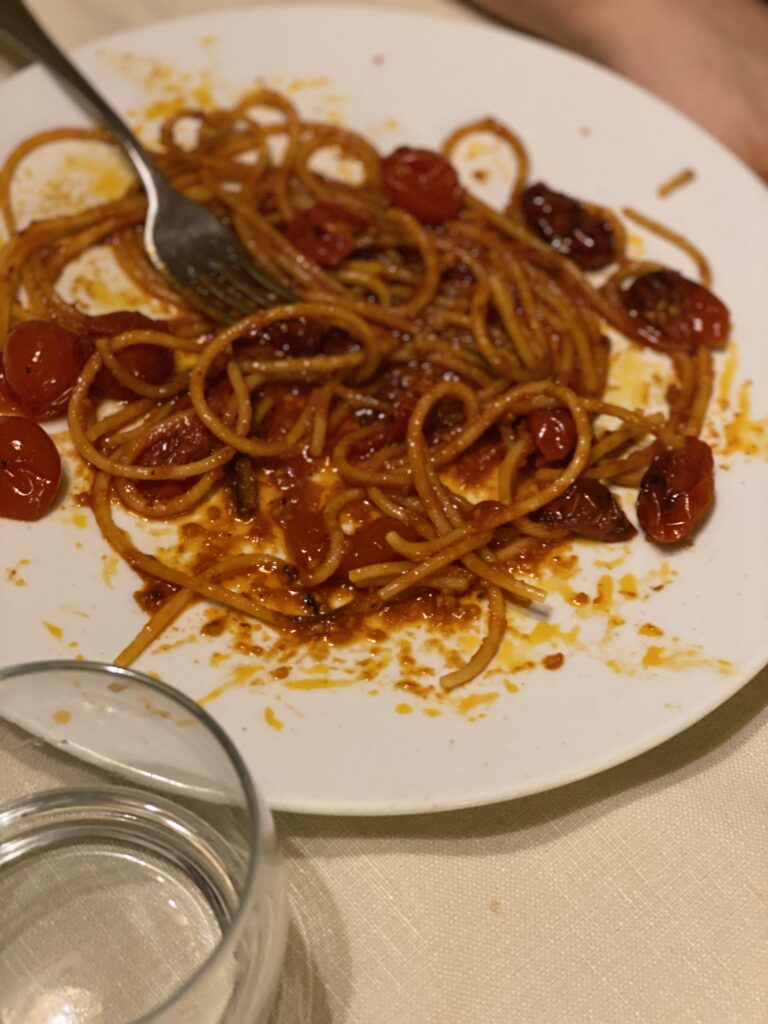
We had ours at a cave restaurant in Matera and it was the spiciest thing any of us have ever eaten. Erin, Dylan and our friend Katie were crying and sweating through what felt like 47 bottles of water while Lisa sat there watching and judging. We could see the chef in the kitchen pouring an unreasonable amount of chili oil and flakes into the pan. It was so hot but none of us could stop eating it. Dylan has craved it ever since and tried to order it at a food hall pop-up back in Rotterdam and was devastated because it was not even close. Once you have had a real one in the south, nothing else compares.
Pane di Matera
Matera's bread has IGP certification and the yeast is made from macerated grapes and figs from the area. Because people used communal ovens in the Sassi, families would stamp their loaves with personal family crests or symbols so they could tell their bread apart when everything came out. Those bread stamps are now sold as souvenirs but the tradition is real and centuries old.
Cheese and Truffles
Caciocavallo Podolico is a cow milk cheese shaped like a pear that gets aged inside the caves for anywhere from one month to five years. And Matera has white truffles, which almost nobody talks about. If you see them on a menu, order them.
Aperitivo
Find a terrace in the Sassi and sit outside as the sun goes down. The view alone is worth the price of a spritz and watching the light change on the limestone while the city gets quiet is one of the best experiences we have had in Italy. This is also why we recommend spending at least one night. The day-trippers miss this completely.

The Upper City and the Castle
There is a modern upper city above the Sassi that is worth a quick walk through, mostly as a contrast. It has shops, cafes and a completely different feel from the ancient part below. You also have to pass through it to reach the castle, which has good views back over the old town. Do not spend most of your time up here but it is a nice counterpoint to the Sassi and gives you a sense of how the city works as an actual living place beyond the historic center.
Films Shot in Matera
Matera has doubled as Jerusalem and other biblical settings in more films than you would expect. The Passion of the Christ, Ben-Hur, The Nativity Story, King David, The Gospel According to St. Matthew and Mary Magdalene were all filmed here. The white limestone city carved into the rock was a natural stand-in for the ancient Middle East.
No Time to Die was the first major film where Matera played itself rather than standing in for somewhere else. The city was incredibly proud of the Bond film when we were there and you could feel the excitement everywhere. The director chose Matera because he described it as a large necropolis, which is a grim way to put it but not entirely wrong when you are walking through cave dwellings that are 9,000 years old.
Visiting Matera with a Dog
We brought both Cash and Rex on separate trips and it worked. The shade from the stacked buildings helps with the heat and there are green trails across the ravine in Murgia Materana park for proper walks. The narrow streets can be tricky with a dog on a leash because the stone is slippery, so be careful on the steep stairways. If the dog decides to go a different direction suddenly, you are going down. Learned that one the hard way.
The green side of the valley across the river is a good spot for longer walks, especially if the heat in the Sassi is too intense. Restaurants with outdoor seating are generally relaxed about well-behaved dogs, which is standard for Italy.


More Matera from the getAwayZ
If you are still planning your trip, these are worth checking out:
Puglia Travel Guide: our full guide to Puglia with beaches, towns and where to stay
Puglia Podcast Episode: the podcast episode covering our summer trips to Puglia
For more, visit www.thegetawayz.com
Matera Italy Travel Guide FAQ
Yes. It is one of the most unique places we have visited in eight years of living in Europe. The history, the architecture and the food make it worth the effort to get there. It is not the easiest city to reach but that is part of what keeps it from feeling overrun.
One full day and one night is enough to see the main sights, do a walking tour and have a proper dinner. Two nights gives you more time to explore at your own pace and experience the city at sunset and after dark when it feels completely different. Most day-trippers leave by late afternoon so staying overnight is a real advantage.
You can. Bari to Matera is about an hour by car or an hour and a half by the FAL train. But we would recommend spending the night if your schedule allows it. The Sassi at night are worth seeing and you miss that entirely on a day trip.
There is no Trenitalia service. Matera is served by a small private railway called FAL that runs from Bari. The ride takes about an hour and a half to two hours and costs around five to seven euros. On Sundays there are no trains, only buses.
Very safe. It is a small city with low crime and the tourist areas in the Sassi are well-maintained. The only real hazard is the slippery limestone streets, especially if it has rained or you are wearing the wrong shoes.
Spring (April and May) or fall (September and October). Summer is extremely hot because the limestone canyon traps heat. Winter is quieter and cooler but some restaurants and attractions may have reduced hours.
Yes. There are cave hotels and Airbnbs throughout the Sassi where you sleep inside actual cave dwellings that have been restored with modern amenities. We stayed in cave Airbnbs both times. The first was at the top of the city and the second was inside the ancient town, which we preferred.
Yes. We brought our dogs on both trips. The shaded streets in the Sassi work well and the trails across the ravine in Murgia Materana park are good for longer walks. Restaurants with outdoor seating are generally fine with dogs.
Planning More Italian Travel
Want to keep exploring? Check out more of our Italy favorites:
Florence, Italy – Art, gelato and easy day trips through Tuscany.
Venice, Italy – Canals, cicchetti and the beauty of getting lost.
Lake Garda, Italy – Lakeside towns, swimming and slow travel by the water.
Where to Stay in Rome – Our hotel picks for every budget across the best neighborhoods.
